Toronto planning committee backs high-rise redevelopment of Swansea Mews
Michael Lewis
More than four years after a ceiling collapse forced Swansea Mews tenants from their homes, Toronto’s planning and housing committee has unanimously approved an application that will see the condemned mid-1970s public housing complex near High Park demolished and replaced with a much higher density development.
The proposed project would quadruple the number of housing units on the existing 5.24-acre site to create one of the city’s largest new publicly owned housing communities, with 649 rental units in two mixed-use high-rise buildings.
It would replace the 154 existing rent-geared to income units with homes ranging from one to five bedrooms while adding 42 affordable units mixed with 453 rent-controlled market homes leased for 99 years.
The design also includes 15,000 – 20,000 square feet of street level retail, community, and amenity space.
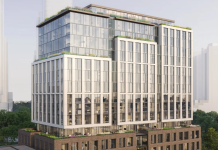
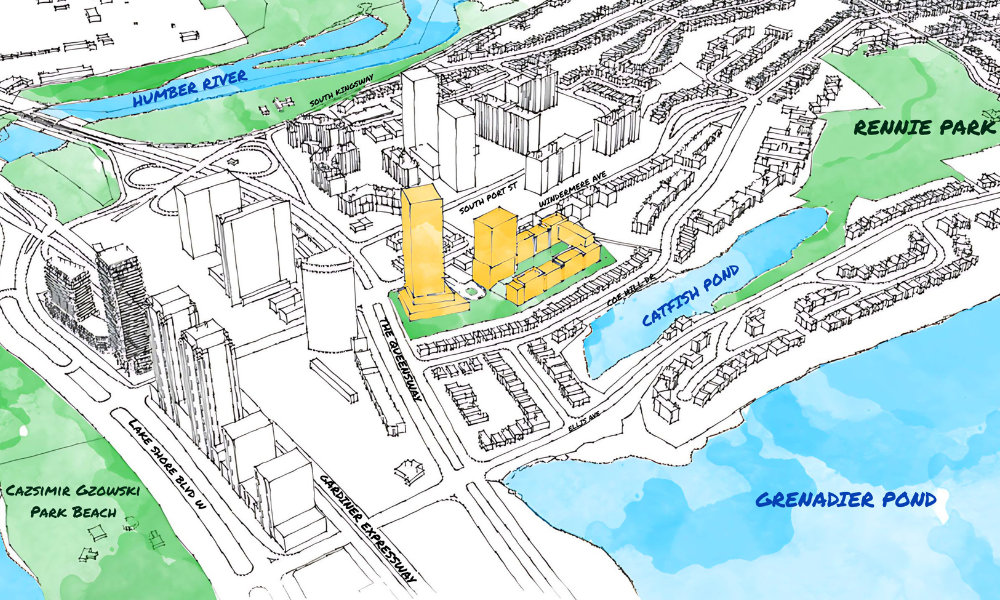
The redevelopment proposal, prepared in partnership with Bousfields Inc., KPMB Architects, and PFS Studio, includes a 35-storey, 120 metre tower at the corner of Windermere Avenue and The Queensway, built on a podium, as well as a second building to the north with a stepped profile ranging from five to 20 storeys.
According to PFS Studio, the north building is designed around a landscaped central courtyard with additional outdoor and green spaces planned throughout the complex, along with retail footage along The Queensway. The plans call for 121 above ground vehicular parking spots including 34 for visitors.
With a combination of towers and street-level amenities replacing nine four-storey blocks of stacked townhouses, a full build out would represent a significant change to the neighbourhood’s character.
The redevelopment application was approved over objections from ratepayers’ groups who say it threatens ecological and hydrological damage while adding to crowding and traffic congestion in the west Toronto Swansea community.
Opponents say the towers will cast shadows on heritage lands and low-rise housing adjacent to environmentally significant areas, wetlands and bird migratory routes. Exempt from the parkland dedication requirement, the proposed development would remove 47 existing trees while preserving 88 existing trees and planting 61 new trees.
“The city’s proposal for redevelopment on the Mews site has failed to address concerns of returning resident and community members,” Swansea Area Ratepayer’s Association director Stefanie Meligrana told the committee meeting.
David Peterson, described in a deposition as an architect “for all stakeholders,” presented a counter-proposal entailing modular mid‐rise buildings of no more than 10 storeys set back from existing homes amid added parkland, suggesting that displaced residents of Swansea Mews are not keen on relocating from townhouses to high-rise structures.
He said the developer’s application for rezoning and an official plan amendment should be deferred so the city can consider alternatives and to allow for an ecological impact study.
Proponents including area councillor and committee chair Gord Perks say the project aligns with the city’s broader housing strategy, which calls for maximizing the potential of existing public housing sites amid a 100,000-applicant waiting list for community housing in the city.
“The context for development has changed,” Perks told the meeting.
While acknowledging neighbourhood anxiety, he said “we simply can’t build back the Toronto that we had 50 years ago. We are approving more density now” than when Swansea Mews was built and Toronto had 2.2 million residents versus about 3.3 million today.
And unlike condominium projects driven by speculative investment, “this is actually designed to meet the needs of families,” he said, with two-thirds of the units including two and three bedrooms.
It would also allow Swansea Mews tenants displaced since 2022 to return to homes at the 21 Windemere Ave. site, said Cynthia Black, a tenant organizer. She said the redevelopment that would expand the city’s portfolio of non-profit housing should proceed as quickly as possible. “It is easier to call for more process when you are securely housed,” she told the committee.
Perks noted that as a Toronto Builds project the redevelopment must conform to Toronto Green Standard tier 2 building requirements as well as provisions to mitigate against migratory bird collisions with the towers envisioned just north of Lake Ontario and west of several ponds and a creek system.
City staff say the towers would be build above the area’s underground aquifers and that the proposed set back is within accepted norms. Perks said the initial proposal was modified to move the 35-storey tower to the southern end of the site away from neighbourhood homes.
In June 2022, following a structural collapse in one of the blocks and poor ceiling integrity in the others, all units were deemed unsafe for occupancy under the Building Code Act.
At the time, 115 units were occupied and all tenants were relocated to other Toronto Community Housing Corp. units by July 2022. A total of 109 tenant households had signed relocation agreements with a right to return to a comparable replacement unit.
Perks said the collapse was due to a “bizarre construction technique where concrete was glued to concrete instead of being in solid pieces.” The company that built Swansea Mews doesn’t exist anymore, he said, adding that the project was downloaded by the province without adequate capital repair funding.
The Swansea Mews application was considered by the housing and planning committee on February 26 and adopted without amendment. City council will vote on the proposal in late March, with plans calling for shovels in the ground by the end of 2026 and completion in 2030.
Financial assistance for the TCHC-owned project is being sought from other levels of government including through the National Housing Strategy. The redevelopment includes more than $116 million in incentives and tax exemptions.